
The Four Levels of AI Adoption
From Basic Prompts to Custom Intelligence
Most companies don’t leap into advanced AI overnight. They evolve through four clear stages of maturity.
Understanding these levels helps you choose the right starting point and know exactly when — and how — to advance. This progression framework is drawn from what we’ve observed helping organizations of all sizes move from experimentation to real operational impact.
Level 01: Basic Prompting & Chat Interfaces
Employees use public tools like ChatGPT, Grok, Claude, or similar directly through web or app interfaces. They manually copy information in and out.
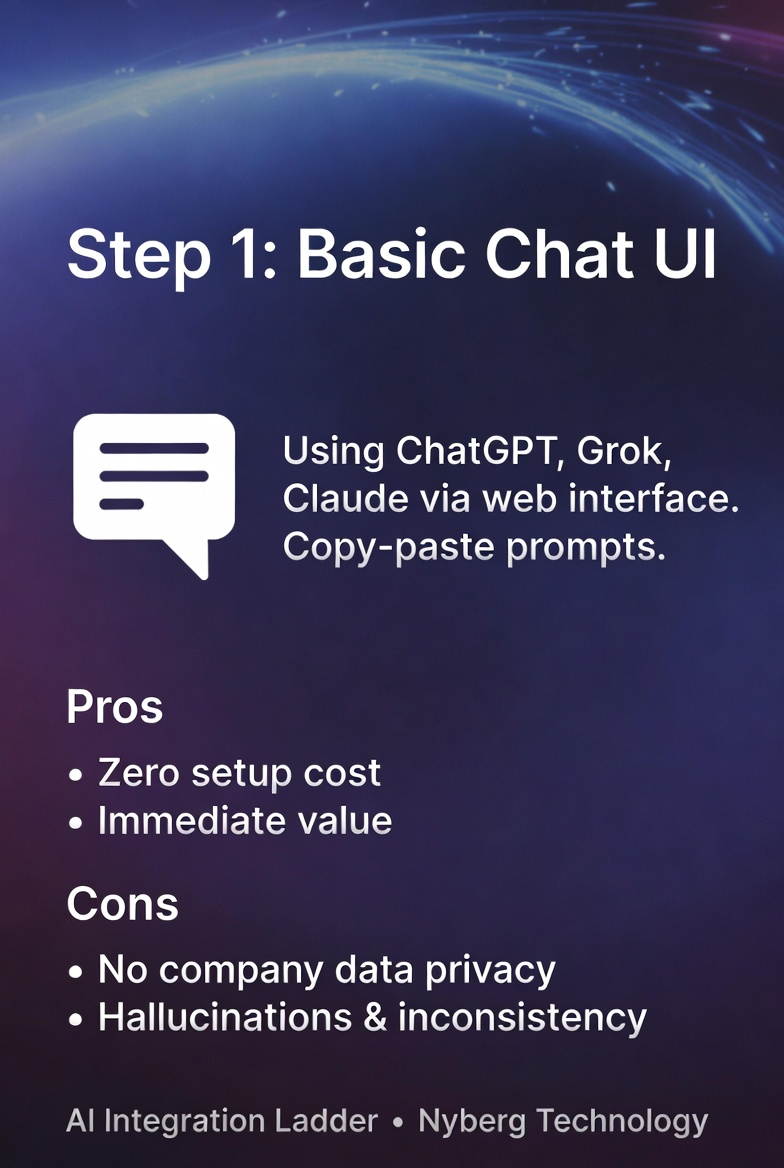
- • No technical setup required
- • Instant productivity gains
- • Accessible to everyone immediately
- • Limited data privacy and security
- • Frequent hallucinations and inconsistent quality
- • Heavy reliance on manual effort
Level 02: Connected Tools & Simple Automations
AI is linked to everyday business tools using plugins, no-code platforms like Zapier or Make, or lightweight APIs. This enables basic automation and file handling.
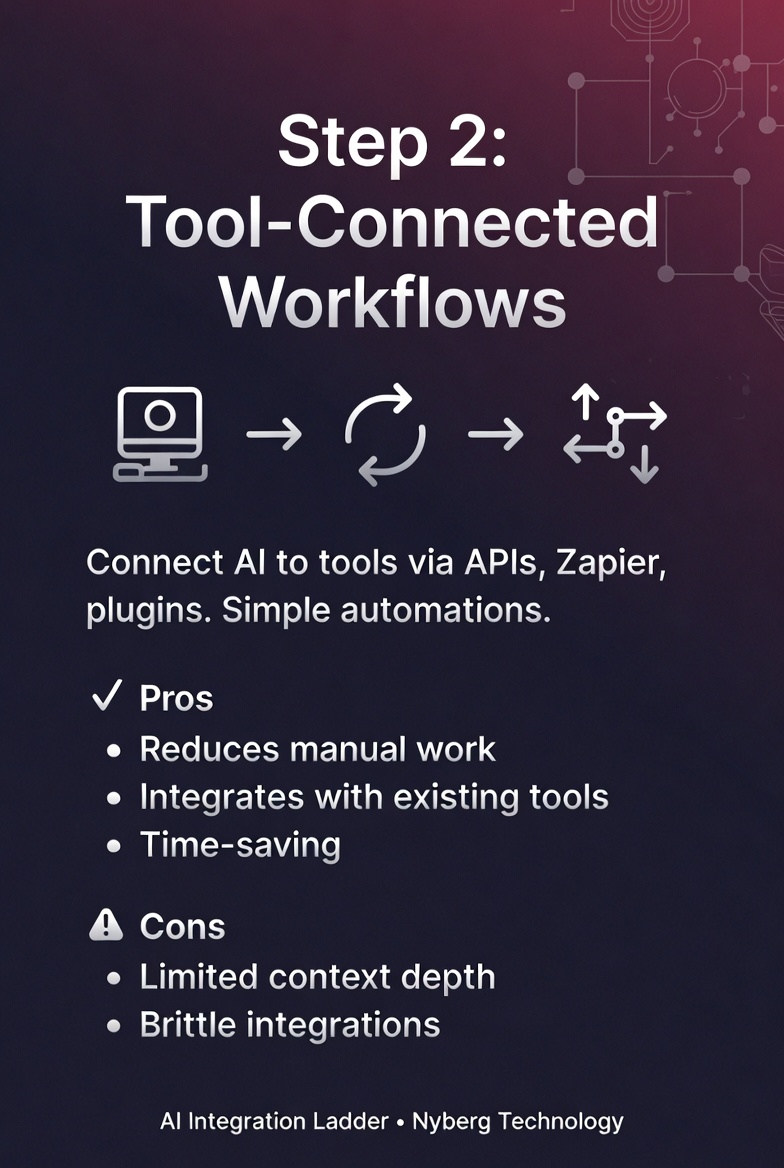
- • Cuts down repetitive manual work
- • Begins connecting AI to existing systems
- • Transforms static chat into more useful assistants
- • Shallow context and understanding
- • Fragile or breakable connections
- • Growing concerns around data security and reliability
Level 03: Secure Data Integration & RAG Foundations
Business data (documents, databases, internal wikis) is safely connected to AI using Retrieval-Augmented Generation — including vector databases, smart chunking, and embeddings.
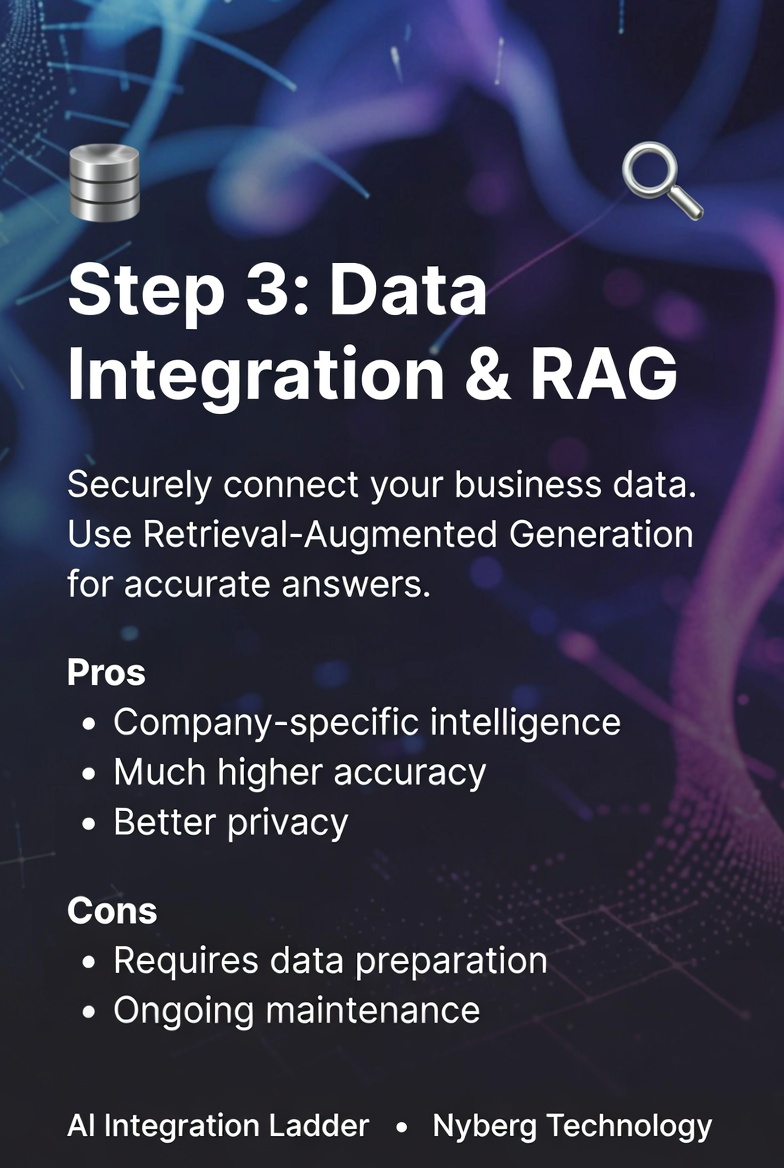
- • Delivers answers grounded in your company’s actual knowledge
- • Significantly better accuracy and relevance
- • Stronger control over data privacy and compliance
- • Requires upfront data cleaning and indexing
- • Needs ongoing effort to keep information current
Level 04: Advanced Customization & Proprietary Systems
Full-scale RAG architectures, fine-tuned models, custom-trained systems, multi-agent workflows, and deep enterprise integration.
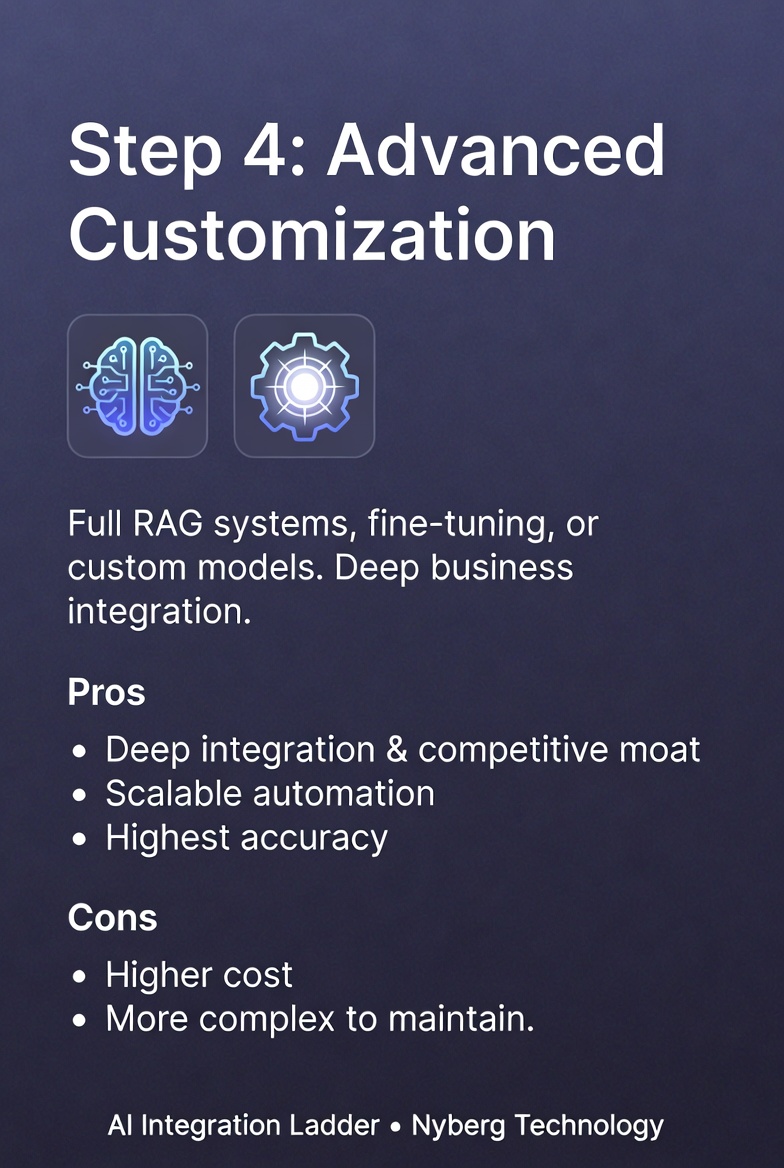
- • Creates genuine competitive differentiation
- • Enables sophisticated, scalable automation
- • Maximum accuracy, control, and business alignment
- • Higher investment in development and maintenance
- • Requires expertise to manage model drift and data freshness
Why Most Organizations Get Stuck
Levels 1 and 2 deliver quick wins with minimal effort, which is why many teams linger there. However, they hit hard limits on accuracy, context, security, and scalability.
The biggest value unlock usually occurs at Level 3 (RAG foundations) and beyond. This is where AI shifts from being a helpful tool to becoming true business infrastructure that truly understands your operations, protects your data, and drives measurable results.
Next Steps
Assessing your current level — and understanding the real requirements to move forward — is the key to turning scattered AI experiments into a durable competitive edge.
Darryn Nyberg
Founder, Nyberg Technology